

219·
1 day agoThis doesn’t really seem fitting to this sub, but I guess this is tech related news because they have multiple websites?
This doesn’t really seem fitting to this sub, but I guess this is tech related news because they have multiple websites?
In most countries, the output of a single prompt will not be copyrightable. However, once someone starts arranging the output into something more, then copyright can be applied.
Overall, it depends on the country, but in some they are asking their legislators for clarification. Many are trying to apply pre-existing copyright laws to LLMs.
The U.S. Copyright Office wrote up a report about this and included a list of how other countries are handling it.
https://www.copyright.gov/ai/Copyright-and-Artificial-Intelligence-Part-2-Copyrightability-Report.pdf

Certainly looks interesting, but I have to mention that I’m not a fan of the Discord Rich Presence feature. The directory access that this typically requires immediately bumps up any flatpak to a medium risk category.
Granted I’m definitely one of those users that does not care to share my current status to all other users as to what I’m watching/listening to at every moment.
That article completely practically skips over the section in the report that says that copyright can be applied by compilation to an overall work. See section II - F: “Modifying or Arranging AI-Generated Content”
Or you can also just skip to the conclusion of the actual report itself:
As described above, in many circumstances these outputs will be copyrightable in whole or in part—where AI is used as a tool, and where a human has been able to determine the expressive elements they contain. Prompts alone, however, at this stage are unlikely to satisfy those requirements.
https://www.copyright.gov/ai/Copyright-and-Artificial-Intelligence-Part-2-Copyrightability-Report.pdf
Edit: The article you linked does mention that the works can be copyrighted as a whole, but it does not mention this in the conclusion.
According to the U.S. Copyright Office, it absolutely can, but it depends on how much control the user exerts on the final product.
If a single prompt was used and they copy pasted the entire thing, then yes, as you have said, it is not copyrightable.
However, if multiple prompts were used and the end result is compiled/arranged with enough direction by the end user, then it can be copyrighted by compilation.
Generating content with AI is often an initial or intermediate step, and human authorship may be added in the final product. As explained in the AI Registration Guidance, “a human may select or arrange AI-generated material in a sufficiently creative way that ‘the resulting work as a whole constitutes an original work of authorship.’”¹²⁶ A human may also “modify material originally generated by AI technology to such a degree that the modifications meet the standard for copyright protection.”¹²⁷
As several commenters noted, human authors should be able to claim copyright if they select, coordinate, and arrange AI-generated material in a creative way.¹²⁸ This would provide protection for the output as a whole (although not the AI-generated material alone).¹²⁹ A relatively common scenario in registration applications is the combination of human-authored text with AI-generated images. In one early case, for instance, the Office found that the selection and arrangement of AI-generated images with human-authored text in a comic book were protectable as a compilation.
knowingly, intentionally continue to fund neo-Nazis in Sweden.
Am I understanding you correctly that you’re accusing anyone who continues to use Mullvad as someone who supports neo-Nazis in Sweden?

Edit: I was thinking of the default defederation list
As far as I understand it, it’s not “hardcoded” in the sense that all piefed instances have it (otherwise I wouldn’t be able to respond to you).
From what I understand, there is a default list, but this can be edited by any instance admins.
Yeah, it happens. ¯\_(ツ)_/¯
I probably could have been more helpful by listing out some specific features, so I went back and edited them in.
Looks like someone is already asking them for clarification in this thread here: https://codeberg.org/Codeberg/Community/issues/2929
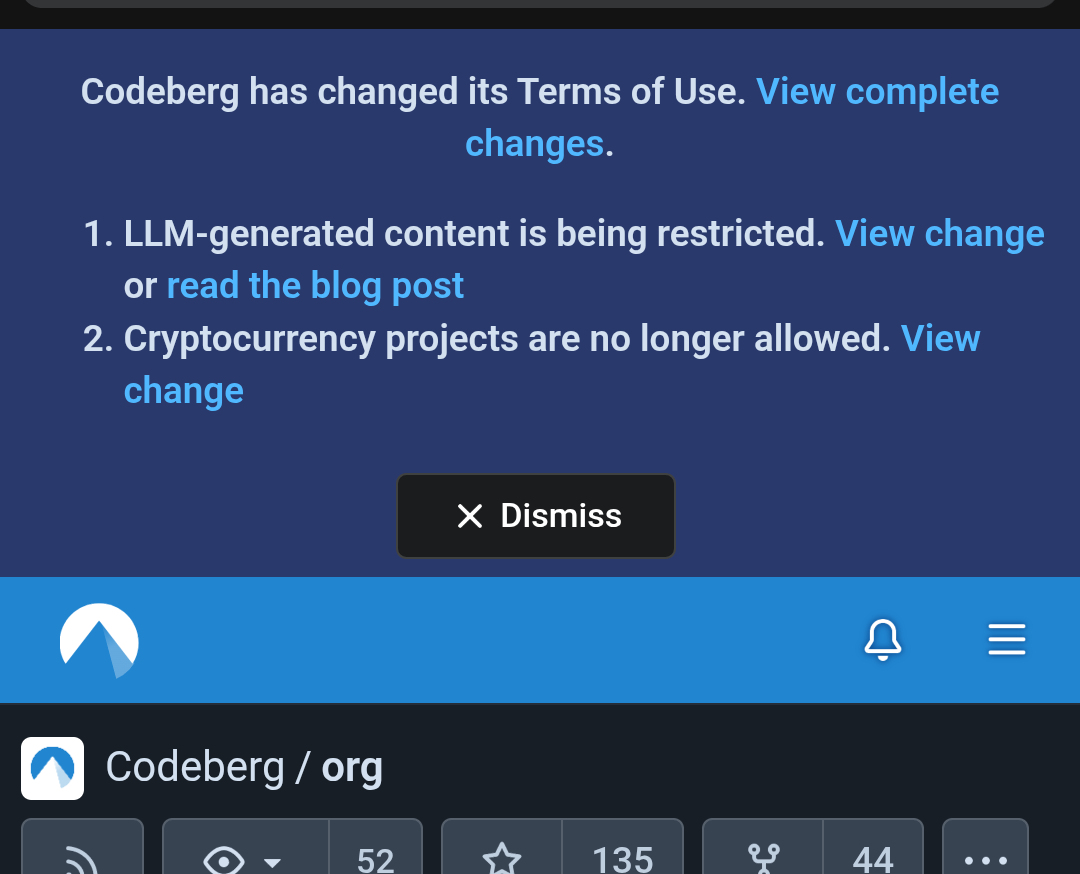
Maybe the banner will be updated to more closely match what Defnulls said. Unless that banner changes it’s certainly not a stretch to say that “Cryptocurrency projects are no longer allowed.”
It’s similar to Lemmy, but with more features and has better integration with Mastodon.
- Edit -
Some specific features that PieFed has:
If that’s supposed to be the correct interpretation, why does the top of the site now state, “Cryptocurrency projects are no longer allowed. View change”?
I’m wondering if there’s some grace period for projects to migrate, or if they just start locking projects down immediately after their community votes to ban something.
It’s a little hard to argue that when the top of the site now says, “Cryptocurrency projects are no longer allowed. View change”.
For “AI editing”, I don’t have much of a problem if a model was trained to tweak the settings in something like Darktable to achieve a good baseline to start with. However, for contributing to research like this, I draw the line when models start generating their own pixels and overwriting the original image.
Hopefully iNaturalist and other similar groups start to look at the metadata of submitted images to help warn/educate end users about this problem. That would at least help with the AI literacy issue. Those metadata tags are already being placed there by the most popularly used tools.
A lot of users here seem to be under the misconception that these are 100% AI generated images.
The problem isn’t really with that as the article states that this is an issue with using AI in the editing process:
Outright hoaxes remain rare and are often easy to spot, said Lees – nobody is falling for a toucan sighting in Siberia – but he says birders often use AI to edit and improve an image, and the algorithm can then introduce parts from different bird species to create the new image.
It’s also worth noting that some phones allow you to zoom in beyond your camera’s normal capabilities by using AI to enhance the picture. With some algorithms this might not be an issue, but if it’s using a model that’s been trained by some animal/object database then this can introduce innaccuracies that would cause problems for researchers trying to keep their database clean.
It works at full resolution, but it’s a cat and mouse game. If something like this becomes popular, then all that needs to be done is to start passing images through a filter first (blur, lower resolution, etc.), or just train a new vision model that can pick out both the blurred message as well as the decoy message.
This will definitely be an interesting case to watch unfold. In my opinion it could definitely be a win if websites that run any kind of meme generator are forced to pay the official artist to have their template on their site.