

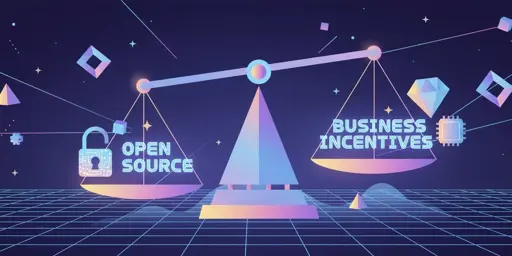
One of the things I discovered (or better said, something I suspected but had the chance to verify) while working on open-sourcing a tool (and API client tool): there is a big (mostly justified) trust deficiency out there .
I could feel it immediately in every discussion: always that little question in the back of people’s minds:
“Will this project “stay true”, or will it change the rules on me later?”
We have seen this pattern repeatedly: Terraform > OpenTofu, Redis > Valkey, Elastic > OpenSearch…
I understand this: it’s becoming hard not to become a little cynical. In some ways, SaaS starts to feel better only because its more honest and at least the incentives and motivations are explicit from day one.
But why does this happen?
One answer is simple: bad intentions, that yeah, they do exist some times. But then this might be an oversimplification.
One aspect that is not often talked about: Many of the most durable open-source tools and frameworks (VS Code, React, Kubernetes, and Backstage among others) were built by companies where the tool itself was NOT the primary revenue engine. Their core business lived elsewhere.
This means that these tools could function as ecosystem infrastructure rather than direct monetization vehicles. They could stay open because they weren’t carrying payroll, sales targets, and investor expectations on their own.
In contrast, when an open-source project becomes the business, the incentives start to shift. The tool now has to “fund” teams, meet SLAs, satisfy investors, and deliver predictable growth.
Over time, that pressure often leads to open-core models, licensing changes, community forks, and growing tension between “community” and “enterprise.”
So yeah, the intentions might have not been alway bad…but the economics have spoken…
The “open source first, monetize later” strategy feels super risky.
Once adoption takes off and the tool becomes central to a company’s survival, teams are forced into trade-offs that often erode trust and fragment communities.
My opinion is that Open Source thrives most easily when it IS NOT carrying the full weight of corporate survival.
When it is, preserving its original spirit becomes much harder.
If we want healthier developer ecosystems, we need to be more honest from the start. This means to either build an open-source project as genuine long-term infrastructure and commit to keeping it open, or build a commercial product with a clear monetization model from day one.
Both paths are valid. Trying to blur the two is what repeatedly leads to broken trust (with developers), frustrated contributors, and fragmented communities.
The takeaway? I guess it is that we just need to be upfront:
If your project is commercial lets be upfront. If it’s truly open, lets commit to it.
Anything in between makes people hesitate to believe and that’s how communities start to fracture.
what do you think? what makes you trust an open-source project long term, and what are the red flags that make you cautious?
There’s a real easy solution to this: use strong copyleft instead of permissive licensing, and don’t require copyright assignment. You won’t be able to rug-pull even if you wanted to!
When project founders refuse to do that, well, now we know their true intentions.
true as well