

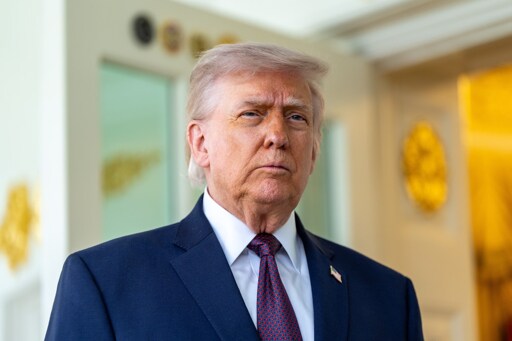
The Trump administration has reportedly canceled an $11 million contract with the Catholic Charities of the Archdiocese of Miami, which offers shelter and care to migrant children entering the United States alone.
The Office of Refugee Resettlement (ORR), part of the Department of Health and Human Services (HHS), has paid Catholic Charities for numerous years to house immigrant children entering the U.S. without adult supervision. The federal government contacted the charity about the cancellation in late March, according to The Miami Herald.
The abrupt severing of the White House’s long-term support to the nonprofit comes amid an ongoing feud between President Donald Trump and Pope Leo XIV. Responding to Leo’s repeated criticism of the Iran war, Trump bashed the pope on Sunday in a social media post in which he called him “weak” on crime and “terrible” for foreign policy, urging him to “get his act together as Pope.”
You realize the church isn’t getting the money, the church is using the money
You’re not hurting the church when you no longer let them use your money to help care for the needy, you’re only hurting those needy
Don’t let your hatred of organized religion distract who this hurts
Although I agree with you there are some fundamental issues here.
First: the Catholic Church does not require taxpayer funding to perform charitable or humanitarian work. When it participates in federal refugee resettlement, it is operating as a contracted service provider, not a financially dependent institution. The dependency narrative is therefore misleading.
Second: embedding a religious organization inside state-funded humanitarian logistics creates an inherent conflict of roles. The government is outsourcing policy execution; the Church is executing civic functions under spiritual identity. That overlap guarantees recurring tension over accountability, neutrality, and influence.
Third: policy reversals under the Trump administration altered refugee intake levels and associated funding flows. Whether one interprets that as governance reform or political disruption, the result is the same: humanitarian delivery systems become unstable when they are tightly coupled to shifting political priorities.
Fourth: the moral inconsistency runs in both directions. It is problematic to weaponize funding decisions as leverage against service providers. It is equally problematic to design humanitarian systems that depend on politically contingent funding streams in the first place.