

cross-posted from: https://lemmy.world/post/49238353
“When losses happen, somebody’s got to pay for it.”
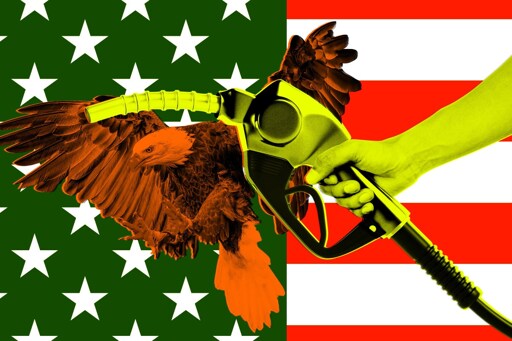
Called Freedom Fuel Network, the enterprise encompasses dozens of gas stations throughout Pennsylvania and New Jersey, USA Today reported, although it isn’t exactly clear which locations are open for business. Plastered in American flag decals and “Freedom Fuel” branding, the gas stations seem to be selling unleaded gasoline for the fixed-price of $3.47 per gallon, about 32 cents cheaper than the current average price in the US.
According to GasBuddy, nearby prices range from $3.85 to as much as $4.49 — no doubt reflecting the slower drip of oil from the president’s costly war on Iran, which burst back into active fighting this week.
As head of petroleum analysis at GasBuddy Patrick De Haan told the Philadelphia Inquirer, the current price of crude oil means there’s no way Freedom Fuel’s $3.47 price point can turn a profit.
“Stations selling at this price, it’s not sustainable,” De Haan explained. “Generally, when losses happen, somebody’s got to pay for it.”
De Haan raises an obvious question: who is paying for it? If the stations are losing money on every gallon, somebody has to make up the difference somewhere — whether out of Trump’s pocket, that of a friendly donor, or the taxpayer’s. And if it’s a private company taking the hit, how long until they stop subsidizing Pennsylvania drivers?
Already, the stunt seems to be distorting local markets. As of Wednesday, a nearby Sam’s Club in Dresher dropped its price to match the $3.47 figure — surely good news for anybody buying gas in South Eastern Pennsylvania, but as always, the devil is in the details.
There is definitely an argument for this. When oil markets get a shock, prices shoot up instantly, but then slowly come back down when the shock is over. The only thing stopping companies jacking up prices as high as they like is the possibility of being undercut by the competition, but it takes time for that to happen. In the meantime, oil companies are able to reap the profits of overcharging. By having a state run offering at a set price, it makes it harder for oil companies to do this, and if the price is inflated enough, the state’s gas can still be profitable, just not as profitable as if they charged inflated prices.
There is also the argument that gas is important to the economy, and as it’s generally a fixed expense (and in many areas unavoidable), the burden of higher prices is felt more heavily by the poor.
On the other hand, it it is unprofitable, then it amounts to the state subsidizing gas, which isn’t ideal compared to investing in more sustainable forms of transit (which would have the side effect of reducing demand for gas and lowering the price, in addition to offering more affordable options for travel).
All in all, it’s probably a bad idea to go around criticizing something that lowers gas prices, which risks alienating people. That’s especially true when there’s so much other awful stuff to criticize Trump for. The main place to cut costs is obviously the military.
Im not a gas station economist, but I have heard gas stations don’t make money from fuel, but from the stuff inside the store like soda and snacks. Could they be doing that?
Perhaps they are selling Trump memoriabilia at his famously not-bargain prices. They could even add one of those crypto ATMs but it only sells Trumpcoin.
That sounds plausible.
Perhaps
But lots of gas stations don’t have stores?
Do the freedom gas stations have stores?
I want the price of oil to permanently be $2028 dollars per barrel
I mean fair, but until public transit is more ubiquitous that would completely shut down large swaths of the country.
I wish there was more public transportation available
deleted by creator