

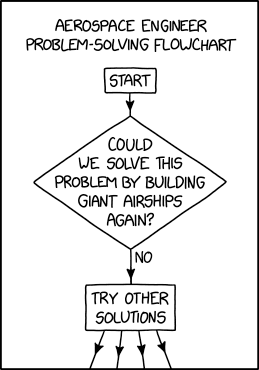
xkcd #3298: Aerospace Flowchart
Title text:
Someday, we will find the problem that goes with this solution.
Transcript:
Transcript will show once it’s been added to explainxkcd.com
Source: https://xkcd.com/3298/
xkcd #3298: Aerospace Flowchart
Title text:
Someday, we will find the problem that goes with this solution.
Transcript:
Transcript will show once it’s been added to explainxkcd.com
Source: https://xkcd.com/3298/
Lifting stuff with an airship is surprisingly terrible.
Why?
Our old arch nemesis, physics…
The problem is not that you can’t build an airship that can lift say ten tons of cargo.
The problem is what you do when you remove the cargo from the airship.
Without the cargo, the airship will be ten tons light, you would need to make sure you could hold it down against a lifting power of ten tons.
Ok, so let’s just fill it with water on the return journey, easy!
How would you do that in sync with removing cargo, the cargo which probably is a cargo container, and is just disconnected, you can’t just suddenly move ten tonnes of water onboard the airship, it takes time to fill up.
Ok so you get another container with a dummy load to enable a simple connect disconnect at the loading dock, fine that would work, apart from what you would do when the next load arrives, do you just manufacture dummy loads and take them back to the start, how do these get back to the other side where they are needed, and why don’t we use the same method to move the initial cargo?
A cargo container of water? You’re literally throwing your hands up at the smallest issues and pretending you hit mount everest.
Not to mention there’s no requirement the weight has to stay the same. Inflating and deflating the balloon controls the buoyancy.
A few solutions I could think of right off the bat:
If you just have a tank for the water, you could just fill it before unloading.
Then you would need a heavier structure to be able to support twenty tons in total, ten tons need to be supported by the landing gear.
This makes things heavier.
Also, where do you get ten tons of water from, where you at the same time can’t drive a truck?
Only carry liquid cargo, pump out of the cargo tank at the same rate you pump into the water tabk. You’d be able to maintain ten tons to an acceptable margin of error.
Clever idea!
Vacuum the lifting gas out of the giant balloon into some storage tanks to compress it and use some smaller balloons as a tiny giant airship to transport the apparatus back?
You need the lifting gas to fill out the envelope and maintain structural integrity, a floppy envelope isn’t amazing at control
Maybe some balloon animal structures inside the balloon to give it a shape?
I started off being a bit silly, but this question is serious. If you had a magic material that was rigid and could maintain that inflated shape for the same weight as the current material they use, could you selectively change its buoyancy by vacuum? Don’t submarines and fish with their swim bladders do the same thing? That would make it a materials problem correct?
Ok, say you have an extremely lightweight yet strong material that you could make a large vacuum chamber out of. It would be quite effective as a lifting device.
And as you note, regulating the pressure inside with bladders would enable you to adjust the buoyancy, this is actually a system that the modern Zeppelin NT uses, though not for adjusting lift in response to loading/unloading, more as a general setting for the area and air pressure.
The NT is usually calibrated to weigh about 300kg and uses movable propellers to move up/down and relies on the airfoil shape of the inflated envelope to generate the tiny amount of lift to stay up while moving forward.
As I always say: Physics knows no favours and no bosses.
Boss wants me to do something that physic doesn’t allow? I laugh at him for his hybris. No, won’t work, because… See first line of this comment.
how hard would it be to have a big anchor that offsets the weight of a couple cargo containers while it fills a ballast with water?